
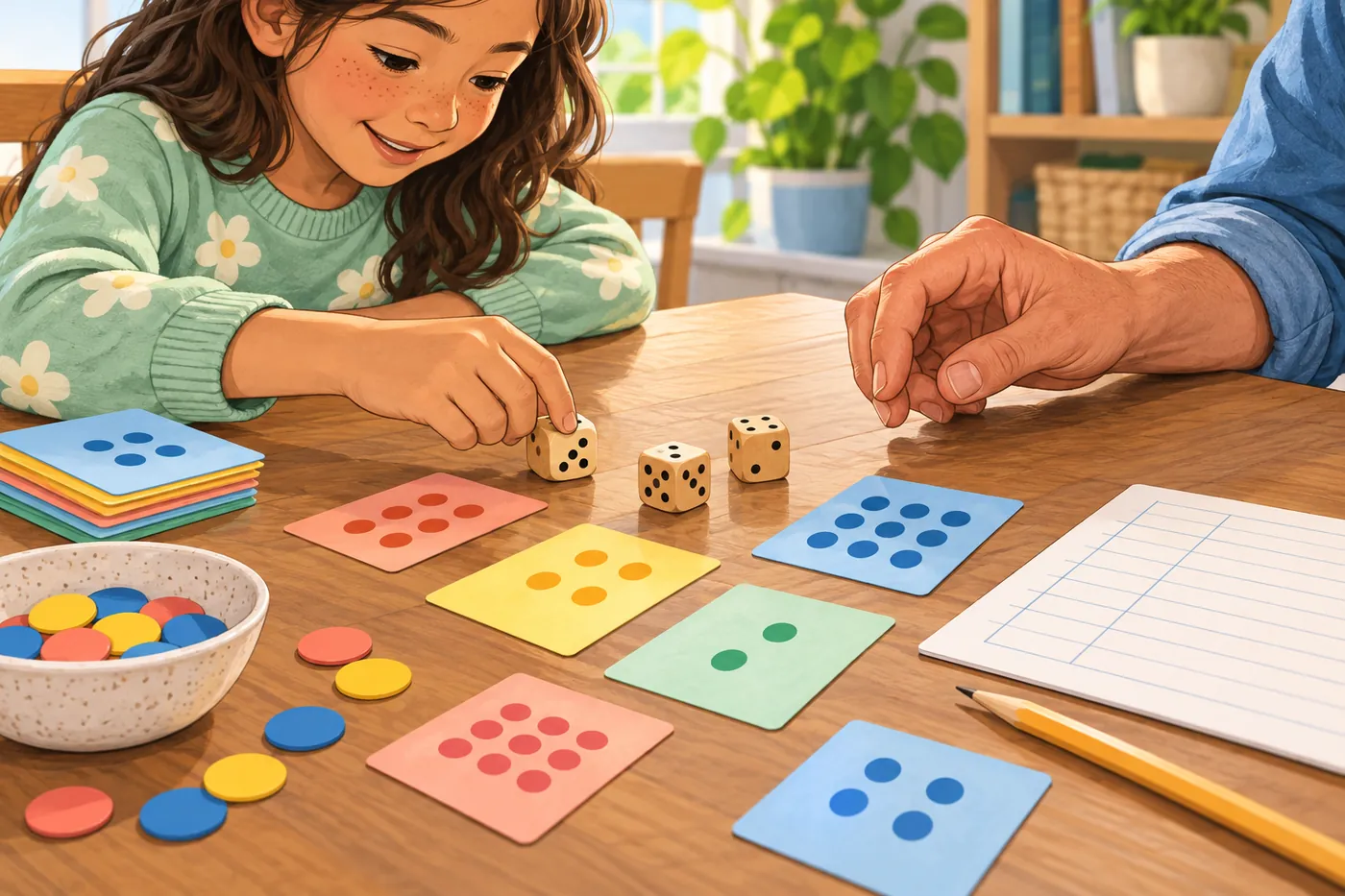
To choose games to learn times tables, start with one question: is the child still counting each step, or do they know some answers and want to recall them more easily?
A useful round gives children chances to recall an answer, check it, and try again after a mistake. Games to learn times tables can use homemade cards, a die, a few counters, and scrap paper. Start with one table, then add more when the answers feel familiar. The activities below work one-to-one, in a small group, or with a class, and their rules do not eliminate a learner who needs extra thinking time.
BEFORE YOU START
Which activity fits the situation?
Choose games to learn times tables by learner and group. Beginners can pair each operation with its answer; learners who know a sequence can practise in a mixed order. Use the guide before reading each game's rules.
- Operation-and-answer memory
- Match each fact with its product and read the pair aloud.
- Multiplication bingo
- Hear a fact, work it out, and cover the matching product.
- Multiplication card battle
- Compare two products and explain which one is larger.
- Dice-and-calculation path
- Move along a track after solving a multiplication fact.
- Cooperative classroom relay
- Build a chain of answers with the whole team contributing.
Keep a reference table nearby. When recall is difficult, rebuild the product with repeated addition and return to the round. These games practise recall; they do not measure a child's ability.
GAME 1
Operation-and-answer memory
This game pairs a multiplication fact with its answer. It suits early review because children can use cards they have already seen rather than reciting a whole table from memory. Prepare a small set and keep a reference nearby.
- Players
- 1 to 4
- Time
- 10 to 15 minutes
- Materials
- Paper cards, with an operation on some and a product on the rest.
How to play
- Choose six to ten products from one or two tables. Write each operation on one card and its answer on another, then shuffle and place every card face down.
- Each player turns over two cards, reads the operation, and checks whether the number is its product. A correct pair stays visible; turn over the other cards again.
- At the end, read the matched pairs aloud. Replay only one or two facts that caused hesitation instead of starting the whole game again.
Adapt it: For a first round, leave operation cards visible and turn over only the answers. To increase the challenge, mix two tables and name both factors before checking the second card.
GAME 2
Multiplication bingo
Bingo practises listening and mental calculation while leaving the board as a visual aid. One person can call the facts for a partner or a small group, and the grids can be drawn by hand rather than printed.
- Players
- 2 to 6
- Time
- 10 to 20 minutes
- Materials
- A number grid for each player, counters, and a list of operations.
How to play
- Draw a small grid and write products from the chosen table in a different order on each player's board. Prepare a shuffled list of the matching operations.
- The caller reads one operation, such as six times four. Players find the product and place a counter on it if it appears on their grid.
- When someone fills a row, read the operations behind those squares and check the answers together before playing again.
Adapt it: If recall is new, allow a reference table after the first attempt. For more practice, alternate between familiar tables while keeping a steady, unhurried pace.
GAME 3
Multiplication card battle
A card battle turns each draw into a comparison. Players talk about factors and products rather than racing to answer. With a young learner, use numbers they have met before and explain how to compare close answers.
- Players
- 2
- Time
- 10 to 15 minutes
- Materials
- Number cards or homemade cards showing the factors being practised.
How to play
- Shuffle and split the cards face down. Each player turns over two cards and multiplies the numbers to find a product.
- Say the full operation and compare the answers. The larger product wins the cards; for a tie, explain both calculations and play another round.
- Write down facts that were difficult and revisit three of them at the end. Do not treat the number of cards won as a measure of skill.
Adapt it: Limit the deck to factors from one to five or focus on a single table. Once products are familiar, ask for a mental explanation before revealing the answer.
GAME 4
Dice-and-calculation path
A path gives a short set of calculations a visible goal. It works well for a child who enjoys board games, as long as moving a counter is not the only reward. Keep the cards to replay after the game.
- Players
- 2 to 4
- Time
- 15 minutes
- Materials
- One die, counters, a hand-drawn track, and operation cards.
How to play
- Draw a track with fifteen spaces. Make a pile of cards for one table, including extra examples of facts that are not secure yet.
- A player draws a card and suggests an answer. After checking it, they roll and move; after a mistake, they use a reference and put the card in a replay pile.
- When a counter reaches the end, each player chooses one card and explains how they worked it out, including a fact they answered correctly.
Adapt it: For a cooperative version, give the whole team one counter for each correct answer. Replace the die with a fixed number of spaces if chance distracts from the calculation.
GAME 5
Cooperative classroom relay
This relay suits a class or group that can work in one area. A cooperative goal avoids ranking children: the team completes a set of facts, and each learner chooses how to take part. A written answer can replace speaking aloud.
- Players
- 4 or more
- Time
- 8 to 12 minutes
- Materials
- A list of operations, a board, and markers or cards.
How to play
- Write eight to twelve mixed facts on a board. Form small teams and give each one a sheet for recording answers beside their question numbers.
- On a turn, one learner chooses an unanswered fact. They can work it out, ask the team for a hint, or pass the marker to someone else.
- Check the sheet together. For each mistake, choose one support: use a known table, draw equal groups, or split the calculation into parts.
Adapt it: In a large class, use individual whiteboards rather than sending learners to the front. Rotate reading, calculating, and checking so participation does not depend on speaking quickly.
A SHORT ROUTINE
Plan a 15-minute practice session
Games to learn times tables can stay short: set a small goal, name the table, agree on a duration, and decide when hints are allowed. Aim to recall a few more facts, not reach a particular score.
- Pick a small goal. Choose four to eight facts from a table the child has seen. Keep two familiar questions for a confident start.
- Play one round. Let the child explain or rebuild an answer. Note hesitation without interrupting every turn to teach.
- Pause to review. Revisit mistakes with repeated addition, a split calculation, or a nearby product they already know.
- Finish with recall. Replay a few accessible facts and name the strategy that helped. Save the missed questions for later rather than making a ranking.
At home, a few short sessions can fit into a calm part of the week. In class, use one activity as a rotating station. Adjust the pace to the group's attention and stop before tiredness takes over.
ADJUST WITHOUT OVERCOMPLICATING
Adapt games for different learners
When adapting games to learn times tables, change one rule at a time. Notice whether the learner counts, recites, or recalls products; a slower answer does not by itself show a lack of understanding.
- For a first try. Choose a familiar table, show the factors, and allow a reference after one attempt. Matching pairs and bingo keep a helpful visual on the table.
- For consolidation. Mix facts from one table and ask for a simple explanation, such as three groups of seven. Drawing is still a valid way to answer.
- To broaden practice. Mix two familiar tables, then add a new one in a later session. Keep enough known facts so the activity does not become a string of stalls.
- For a mixed group. Offer roles such as reader, calculator, counter placer, or checker. A shared goal lets everyone join without comparing speed.
KEEP PRACTICE USEFUL
Three easy pitfalls to avoid
Making speed the main goal
A timer can make a round stressful before facts feel familiar. Start without a limit; if the child asks for a challenge, keep it short and compare only their own attempts.
Changing several rules at once
If the game feels hard, first reduce the number of cards or tables. Keep the other rules unchanged so you can see what helped.
Playing only known answers
Keep the round enjoyable but include two or three uncertain facts. Replay them after a hint, then end with calculations the child can solve.
COMMON QUESTIONS
FAQ about multiplication games
Why can games to learn times tables help?
A cooperative spoken relay needs only a list of operations. For a quieter activity, write a few facts on paper and let the child choose one to explain.
How long should a game last?
Plan for about eight to fifteen minutes for a small set of facts. The right duration depends on age, tiredness, and attention.
Should we begin with one table?
It is a useful starting point when several answers are new. Later, mix two familiar tables to check whether the child can retrieve facts in a different order.
What should I do when a child makes a mistake?
Stay neutral, name the operation, and offer a known strategy such as repeated addition. Let the child replay that card later.
Can these activities work with a whole class?
Bingo and the relay can work with a class when roles are clear. Small groups, whiteboards, and shared checking reduce waiting and individual pressure.
Can an online tool be used as well?
Yes. A short screen-free round can be followed by an individual quiz to find facts to revisit. Use both formats for practice rather than comparing children.