

To learn from a times tables speed test, note three things together: correct answers, mistakes, and questions left blank. A score by itself does not explain what to practise next.
Timed practice may use a worksheet, spoken questions, or an online quiz, and each format can follow different rules. In this guide, a times tables speed test means a short, timed round based on multiplication facts the learner has already studied. Before starting, agree on the tables and the duration. Keep both the same when comparing attempts so that a change in difficulty is not mistaken for progress in speed.
BEFORE THE TIMER
Start with a baseline attempt
The first round describes a starting point; it is not a grade. Choose familiar material, such as the 2, 5, and 10 times tables, or one table studied this week. Decide whether questions will stay in order or be mixed. An ordered list also tests whether the learner can recite a sequence. Mixed questions ask the learner to retrieve each product without leaning on the one before it.
Explain the directions, show one example, and check that the learner knows how to answer. On paper, leave enough room to write. For spoken questions, read each operation at a steady pace. For an online quiz, keep the same answer method and range of tables for the next comparison. Remove distractions, and stop if fatigue makes the activity uncomfortable.
Record the duration, tables included, correct answers, mistakes, and unanswered questions. Add a brief note about what happened: a product was forgotten, a calculation went wrong, or the direction was misread. These details make a baseline more useful than a single number. No result from one short attempt is an official level or a general measure of school ability.
| What to record | Why it helps |
|---|---|
| Duration and tables | Keep the conditions alike when you compare sessions. |
| Right, wrong, and blank | Separate accuracy from how many questions were reached. |
| Facts that caused a pause | Choose a small review set instead of repeating everything. |
Keep in mind: Save the first result as a description of that session, not a promise about the next one.
CHOOSE A FORMAT
How to plan a times tables speed test
A useful duration gives the learner time to answer several questions without making the round feel like a race. One minute can work for a short, familiar set; 100 seconds allows more time for a wider mix. These are practice examples, not official school standards or goals for every child. A beginner can start without a timer or with only a few operations, then add a limit after the directions feel familiar.
The material also changes the difficulty. Mixing tables the learner already knows practises recall. Keeping one table on its own can help when that is the current learning goal. Do not compare a familiar table with a new mixed set as if they were the same task. For a fair times tables speed test comparison, keep the table range, number of questions, and response method steady.
Change one condition at a time. If the duration gets longer, keep the tables and question style the same. If accuracy drops, return to a shorter round or remove the timer. A comfortable practice format should make the next step clear, not add pressure to finish at any cost.
| Practice format | When it can help |
|---|---|
| No timer | Learn the directions, explain a product, or lower pressure. |
| 60 seconds | Try a short, familiar round and get a simple baseline. |
| 100 seconds | Extend practice when the learner is comfortable with the format. |
| Mixed tables | Retrieve products without reciting one sequence. |
Remember: The same score can mean different things when time, question count, or table range changes.
ORDER OF PROGRESS
Protect accuracy before chasing speed
Speed practice becomes more useful when a learner can retrieve a product without recounting on fingers or rebuilding the whole addition each time. If an answer is uncertain, use a strategy the learner understands. For example, 7 × 8 can be rebuilt by doubling 7 × 4: first 28, then 56. The purpose is not to ban strategies; it is to make familiar facts easier to retrieve.
A simple sequence is to review a few facts, answer a short set, and correct hesitations. If the learner rushes and makes more mistakes, remove the timer. A correct answer that can be explained is more useful than a fast guess. A times tables speed test is one way to practise recall, not a complete measure of mathematical ability.
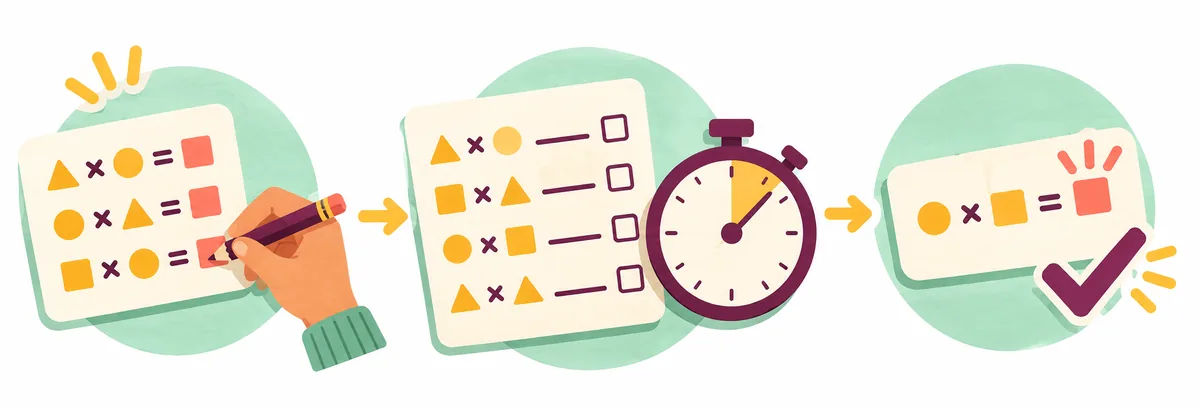
- Review: Look at the operation and explain a familiar strategy.
- Answer: Try a small group of questions in a calm setting.
- Time: Add a short timed round after the directions are understood.
- Correct: Revisit uncertain facts before starting another attempt.
Example: After a mistake on 7 × 8, find 56 together. Ask a related question later instead of immediately restarting the whole worksheet.
AFTER THE ROUND
Turn mistakes into useful practice
Correct the work without making the result personal. Ask how the learner chose an answer. Perhaps a product was forgotten, a familiar calculation went wrong, two digits were switched, or the direction was hard to follow. Those situations need different kinds of help. Aim for one useful next action, not a long list of criticisms.
Choose three to five facts to revisit, then mix them with products the learner already knows. Rebuild a missed fact using repeated addition or a nearby product. If a question was left blank, record it separately from a wrong answer. This gives the next session a clear focus and keeps the review manageable.
- Forgotten product: Retrieve it with a strategy or a nearby known product.
- Calculation slip: Work through the steps again without a timer.
- Misread question: Identify both factors before choosing an answer.
- Rushed response: Add a brief check before the next answer.
| Example result | A careful reading |
|---|---|
| 18 correct, 2 wrong, 5 blank | Twenty of 25 questions got an answer; 18 of those were right. Keep the five blank items separate. |
| Fewer answers, few mistakes | Check time, reading, and familiarity before drawing a conclusion. |
Avoid: Repeating every operation immediately. Return to a few selected facts after a break or in the next session.
A SHORT ROUTINE
Plan a ten-minute practice session
A brief routine is easier to repeat than a long daily test. Pick a time when the learner is available, prepare the materials, and agree on how long to work. An adult can read operations or check answers, while the learner stays clear about what they are practising. The session does not need to end with a record score.
Adjust the example to the learner. A beginner can answer without a timer; someone who is comfortable can mix more tables. Leave a few minutes to discuss the result and choose what to review next.
- 2 minutes — recall: Read a few products and explain an uncertain answer.
- 3 minutes — practise: Answer a small set without aiming for a record.
- 1 minute — pause: Take a breath and get ready for the short round.
- 1 minute — test: Use the same format chosen for this practice session.
- 3 minutes — review: Discuss mistakes and pick a few facts for next time.
Stay flexible: These times are examples. Stop or shorten the routine if attention fades or the timer starts to feel stressful.
TRACK WITHOUT COMPARING
Notice progress without ranking learners
Compare several sessions with the same duration, answer method, and a similar level of difficulty. One attempt can change because of fatigue, attention, or the order of questions. Look at correct answers, mistakes, and completed questions together. When those details move in a helpful direction, they show more than time alone.
Avoid leaderboards and required targets. Familiarity with the tables, typing, and question layout can all affect the result. A slow answer that is understood may show learning in progress, while a quick guess does not necessarily show secure recall.
Choose one observable next step, such as reducing a repeated confusion or keeping accuracy steady on a familiar set. If accuracy falls, return to the previous format. Progress is not always even, so let the next practice plan respond to what happened rather than demanding a new record.
- Notice: Which tables were practised, recalled, or missed again.
- Adjust: One condition, such as duration or mixed questions.
- Recognize: An understood strategy or corrected mistake, not only a record.
Limit: A short test describes one session; it cannot show complete mastery of mathematics by itself.
COMMON QUESTIONS
Questions about timed multiplication practice
How many correct answers should a learner get on a speed test?
There is no universal threshold for every duration, age, and question list. Read correct answers alongside mistakes and unfinished questions, then compare sessions built in the same way.
Should we choose a 60- or 100-second round?
Start with the duration that feels comfortable. One minute can suit a short familiar set; 100 seconds gives more time for a broader mix. These are practice examples, not school standards.
What if a child knows the tables but answers slowly?
Check that the directions make sense and that the products are correct. Practise a few uncertain facts, then try a short round again. Slowness alone does not show a general learning difficulty.
Can I compare results from different tests?
The comparison is weak if duration, tables, question order, or answer method changes. Keep conditions similar and note accuracy separately from the number of questions reached.
Does a times tables speed test replace regular practice?
No. A timer can show quick recall, while explaining a calculation, solving a problem, and untimed practice show other parts of learning. The formats can complement one another.
Where can we try an online times tables speed test?
The homepage quiz has a timed mode. Choose the tables, answer a short round, then revisit the facts that caused difficulty instead of focusing only on the score.